Steer Group: QueensLink Initial Business Case | 2026
Download the report here:
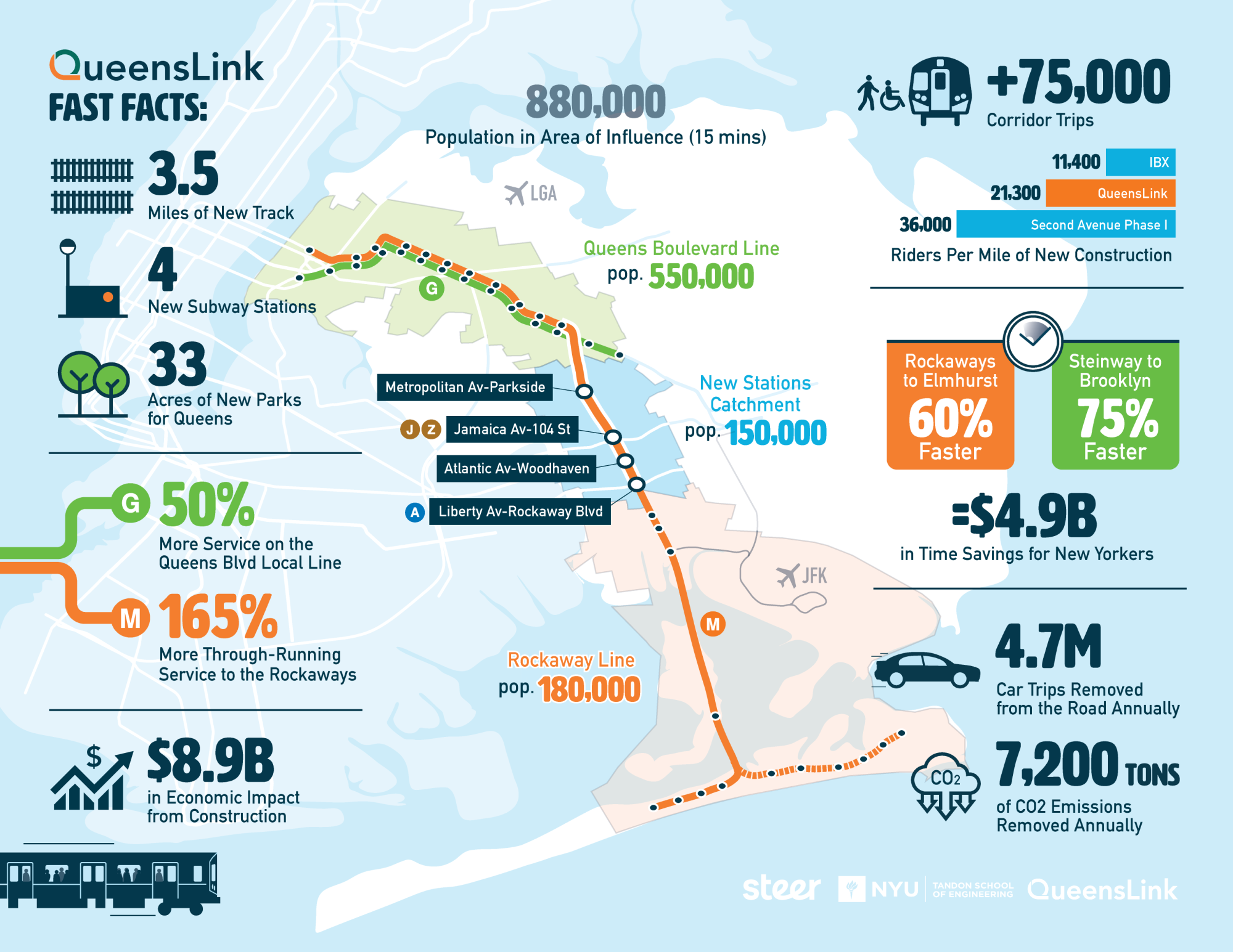
This document is the Initial Business Case (IBC) for the QueensLink project. The purpose is to set out the strategic rationale for the project before major funding or procurement decisions are made. It is intended for a broad audience, including residents, community organizations, and key decision makers interested in the QueensLink
project and how it can transform their commutes, businesses, and quality of-life. It is also intended to highlight
how the project supports wider MTA and NYC goals.
The IBC is divided into four cases that consider different attributes of the project: the Strategic, Economic, Financial, and Deliverability and Operations Cases, supported by quantitative and qualitative evidence.
The Strategic Case
The Strategic Case tells the “QueensLink story” and investigates common questions about the project. It sets out a series of challenges and corresponding opportunities that the project can address and describes the benefits it will deliver.
The Economic Case
The Economic Case quantifies the benefits of QueensLink for transit users, park users, and wider society. It compares the sum of these benefits against the cost to build and operate QueensLink over a 30-year assessment period, known as a “benefit-cost ratio” (BCR).
The Financial Case
The Financial Case asks and answers the question, “How much will this affect the MTA’s capital and operations budgets during and after construction?” It shows that while QueensLink will generate some fare revenue, it will ultimately require subsidies from the city and state, as is standard for transit projects.
The Delivery and Operations Case
The Delivery and Operations Case describes potential service patterns on new QueensLink infrastructure and selects an initial service concept to inform the rest of the IBC. It also shows how the project could be delivered and
the specific challenges and mitigations that may alter how and over what time period QueensLink could be built.
As an Initial Business Case, many of the four areas are only developed at an outline stage. They would be
expanded upon as the project becomes more fully developed in the coming years. The primary focus of the IBC is to demonstrate QueensLink’s strategic rationale and benefits, and to guide its development to the next planning
stage.
This study would not have been possible without the generosity of over 1,600 individuals through our GoFundMe campaign in January 2025. Thank you!
NYU Center for Urban Science and Progress: QueensLink Environmental Impact & Accessibility Analysis | 2026
Download the report here
Abstract:
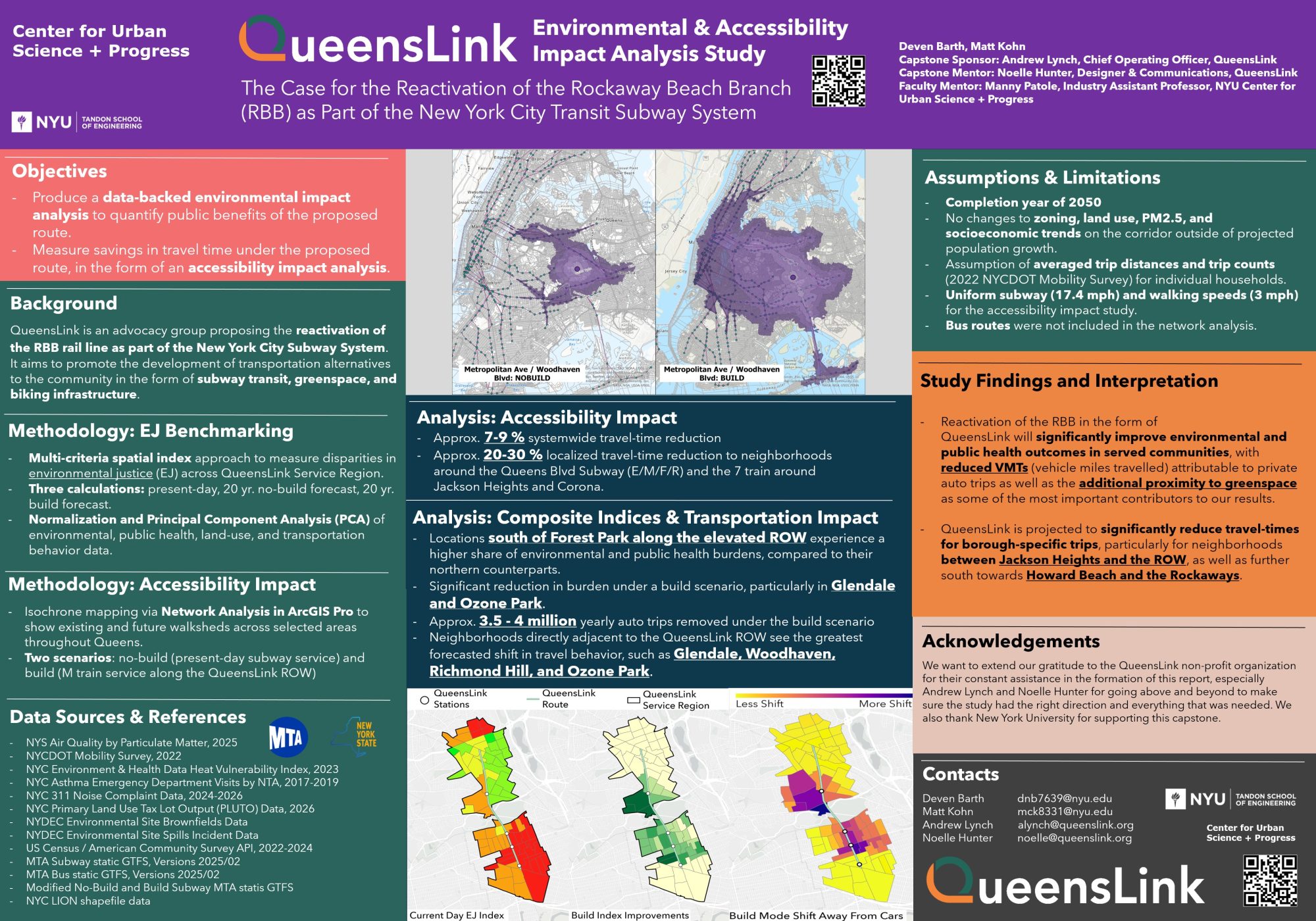
QueensLink is an advocacy group proposing the reactivation of the abandoned Rockaway Beach Branch (RBB) rail alignment as part of the NYC Subway System, with the goal of improving environmental, public health, and mobility outcomes to residents living in Outer Queens, namely through added subway transit, bike infrastructure, and greenspace. With the use of publicly available data, we produced a comprehensive environmental/transportation impact analysis in order to quantify and benchmark public-oriented benefits of the proposed route, with respect to present-day environmental/transportation burdens.
We also performed a rigorous accessibility impact study to further quantify the benefits of added rail service, in the form of measuring travel-time savings. We found that QueensLink has the potential to significantly improve environmental and public health outcomes across the immediate service region, with reduced transportation-induced Vehicle Miles Traveled (VMTs) and proximity to greenspace among the core contributors. We also noticed significantly reduced travel-times under QueensLink, specifically for local trips within the borough.
NYU Center for Urban Science and Progress: QueensLink Ridership Study | 2025
Download the report here
In 2024, QueensLink began working with graduate students at the New York University Center for Urban Science and Progress (CUSP) on a capstone project that would evaluate ridership on QueensLink. Using the USDOT FTA STOPS modeling software and open data from NYMTC and the MTA, the students built different scenarios to determine which service patterns (i.e., which train lines) would be best to operate along the QueensLink.
The purpose of the report was twofold: to gain a clearer understanding of where new ridership was coming from along the entire QueensLink corridor, and to determine which potential service would be a more preferable alternative. As the STOPS model looked at the entire network, not just the new stations, different service levels and patterns could be tested. Additionally, the ongoing Interborough Express (IBX) project between Brooklyn Army Terminal and Jackson Heights was also modeled to examine the impacts of this new service on QueensLink’s ridership. The model adapted MTA surveys, available Open Data reporting of existing ridership, and open-source GTFS schedules to provide a clearer post-COVID understanding of ridership growth, as well as data obtained from NYMTC and USDOT FTA via the support of NYU faculty.
The data and results in this report was used as the basis for the Steer Group’s “QueensLink Initial Business Case”, which helped refine the model and expand the findings using real world operating costs.
TEMS: QueensLink Corridor Analysis | 2021
Download the report here:
- The QueensLink Corridor Analysis: Phase 1 Preliminary Assessment Executive Summary June 2021 [PDF]
- The QueensLink Corridor Analysis: Phase 1 Preliminary Assessment Report June 2021 [PDF]
- MTA 2019 Rockaway Beach Branch reactivation feasibility study
In 2019 the MTA released their Rockaway Beach Branch reactivation feasibility study. The study found that restoring service on the line is possible but their cost estimate of between $6 and $8 billion looked wildly out of line with similar projects. QueensLink has commissioned a study by the transportation firm TEMS to determine why these numbers seemed so high. Additionally, the official report did not go into detail about the potential economic benefits of building the line.
The purpose of this report was to 1) analyze the cost estimates of the official MTA feasibility study and 2) determine the economic return of such and investment.
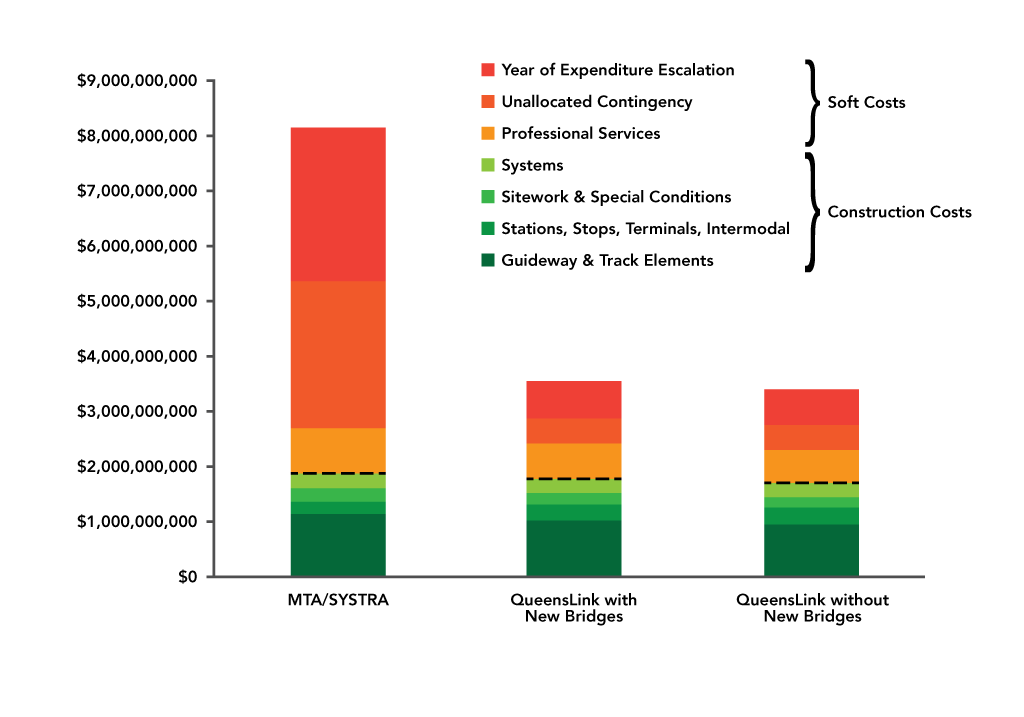
The official cost estimate of $8.1 billion was inflated using non-standard contingency and Year of Expenditure Escalation calculations (based on FTA guidelines) and higher Professional Service fees. A more accurate estimate puts the cost at $3.4-$3.7 billion.
Based on similar projects, notably the Purple Line outside of Washington, D.C. and the Hudson-Bergen Light Rail in New Jersey, over the course of the lifetime of the project the QueensLink could: create up to 150,000 new jobs (short term construction and long term growth), create up to $13 billion in personal income from new economic opportunities, and create up to $75 billion in property value along the route.
Document Library
2025
New York City Independent Budget Office
2025
NYPIRG Straphangers Campaign
2023
NYU Wagner School of Public Service
2016
Dept of City and Regional Planning UNC Cahpel Hill
2014
Dept of Urban Studies, Office of Community Studies Queens College
2001
MTA, AECOM, et al
1996
The Committee for Better Transit, IRUM